Do we really want a seat at the top table?
This is a question I've been asking myself following a massive response to a recent LinkedIn post I wrote. That post was reflecting that in all the NHS England and ICB new structures, the chief pharmacist role is sitting outside of the executive team, and is almost always reporting into someone from another profession.
The messages and comments were pretty unified in their perspective - Pharmacy has huge potential, medicines are high profile, and so we need to be round the top table. We want to be closer to the decision-making.
That feels entirely reasonable. Pharmacy has expertise that is relevant and timely. Medicines sit at the centre of cost, quality, and outcomes, so it would be odd if the profession did not want a stronger voice in how decisions are made.
Because where pharmacy often operates now has some advantages. We are asked for advice, and we are recognised for our expertise. We run operational services and leave the big strategy and really difficult decisions to others. There is a degree of professional safety in that position. You can be right without being responsible.
The dynamic changes quite quickly when you move closer to decision-making. At that point, the role is no longer to provide a view on what could or should happen. It is to decide what will happen.
Decisions in complex systems like the NHS are rarely about identifying the best technical answer, or interpreting the data to arrive at the right solution. More often, they are about navigating between competing priorities, each of which has some legitimacy. These are not problems that can be resolved through analysis alone. At some point, a judgement has to be made.
That judgement carries weight. It requires someone to say, 'in this context, with these constraints, this is the direction we are going to take'. It also requires that person, or group, to live with the consequences of that choice, including the ones that were foreseeable and the ones that were not.
This is where the idea of influence becomes more complicated. Influence is not simply about having your perspective heard or your expertise recognised. It is about being part of a process that lands on a decision, and then being associated with the outcome of that decision.
That brings a different level of scrutiny. You cant't stand outside the decision and critique it.
There is also a more subtle shift that happens in how you think. In an advisory role, it is possible to hold multiple positions at once. You can describe the benefits of an option and its limitations without needing to put your name to an unpalatable one. In a decision-making role, you don't get to hide from it.
That resolution is where accountability sits. It is also where many professionals, not just in pharmacy, start to feel uncomfortable. The training and culture of the profession place a high value on accuracy, completeness, and being able to justify a position. Decision-making in complex systems often requires a willingness to act on incomplete information, to accept that some consequences cannot be fully predicted, and to take responsibility for the balance that has been struck.
We already make decisions, often complex ones, in clinical and operational roles, but strategic and executive decisions are different in kind, they are less about solving a problem in front of you and more about deciding which problems you will prioritise.
None of this is an argument against pharmacy having greater influence. If anything, it is the opposite. The system would benefit from more clinically informed, thoughtful decision-making, and I think we have a professional perspective that is under valued and not heard. But it does suggest that influence can't be understood as a simple extension of expertise.
The next question, then, is not just whether we want a seat at the table, but whether we understand the table itself. Because decisions are not made in a vacuum, they are made in rooms shaped by pressure, constraint, and competing priorities. Understanding that environment is a prerequisite for influencing it.
And as my friend Ben Hannan said:
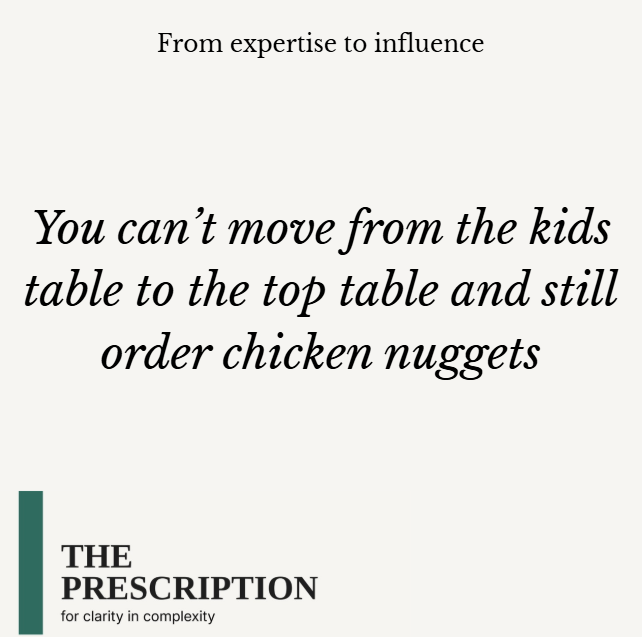
Moving from the kids table to the top table means accepting that you don’t get to order chicken nuggets anymore.
- May 20
A seat at the top table?
- Ewan Maule
- 0 comments