Thanks for reading! Subscribe for free to receive new posts and support my work.
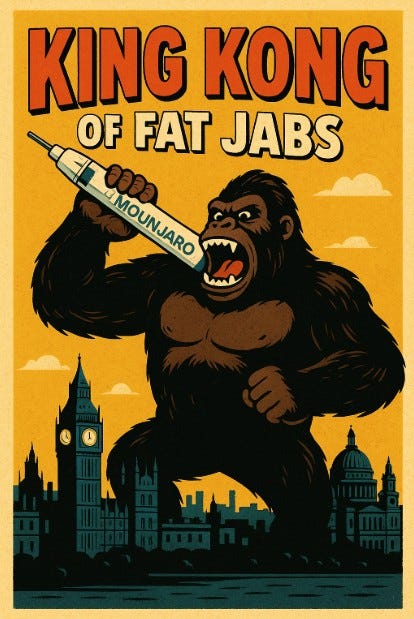
Some medicines make headlines for a day or so. Mounjaro — Eli Lilly’s injectable for weight loss and type 2 diabetes — is not one of them. Branded by the media as “the King Kong of fat jabs” it’s become the poster child of a new generation of weight-loss drugs dominating healthcare debate, social media and celebrity gossip columns.
But on 14 August 2025, it made the headlines for a very different reason. Eli Lilly announced that the UK list price would increase by up to 170% from September. The highest (15mg) dose will jump from £122 to £330 per month, with smaller but still significant rises — between 45% and 138% — for the lower doses.
The company’s explanation? They’re “aligning UK prices with other developed markets.” The timing is no accident — it lands alongside ongoing political pressure from the United States, where Donald Trump has long argued that Americans “subsidise” lower drug prices overseas and the pursuit of “most favoured nation” status.
Photo by Library of Congress on Unsplash
The NHS won’t see a change to what it pays, thanks to confidential commercial agreements. But that safety net doesn’t extend to private patients — people paying out of pocket because they don’t meet the very strict NHS eligibility criteria. And make no mistake, the private market for these drugs is enormous - up to 2 million people in England alone using this every month.
For these patients, the price hike is brutal: an extra £208 a month, or more than £2,500 a year.
It’s not just numbers on a page — it’s the choices people will have to make:
A 45-year-old managing their weight privately because NHS thresholds exclude them now deciding whether to pay for their medicine or keep paying their mortgage.
A parent who’d finally felt in control of their weight calculating if they can afford to stay on treatment while still paying for after-school childcare.
A manual worker who’s lost five stone on Mounjaro fearing they’ll lose momentum, confidence - and maybe even their job — if they have to stop.
For them, the “King Kong” nickname has taken on a more ominous meaning: a huge, immovable cost looming over their health decisions.

Photo by Raghavendra V. Konkathi on Unsplash
Yes, even at £330 a month, Mounjaro’s UK price still sits below U.S. retail levels. But the size of the jump matters more than our position in the league table.
This isn’t the UK suddenly becoming expensive in global terms — we’ve historically driven medicine acquisition prices down to some of the lowest in the world. What’s happening is that we’re being pulled upwards into a tighter price band with our European neighbours — a shift that will be noticed and used in price negotiations far beyond our borders.
Our historic low drug pricing has been one of the bedrocks of the sustainability of the NHS. Once we lose that, the perilous state of both the NHS and national economy starts to look under significant threat.
This isn’t just about a company cashing in (although people will have their own views on that - Eli Lilly is worth over £450 billion) — it’s about the intersection of politics, policy, and market dynamics:
U.S. pressure – Trump-era rhetoric about “freeloading countries” is showing up in corporate pricing strategies. Increase prices abroad and you strengthen your case for keeping them high at home.
Market leverage – Mounjaro is a blockbuster with huge unmet demand and, for now, little direct competition. High demand plus constrained supply equals big pricing power.
International ripple effects – Many countries use international reference pricing. If the UK price goes up, it can be used to push up prices elsewhere.
Drug pricing is never purely domestic. A policy move in Washington DC can land on a private patient’s bank statement in Washington, Tyne and Wear.
For the moment, NHS patients are insulated — but there are three big risks ahead:
Private access shrinks – As private prices rise, only NHS-eligible patients can get the drug, taking the decision to self-fund out of many people’s hands.
NHS cost exposure – Confidential discounts work until they don’t. Over time, higher baseline prices affect negotiations, rebates, and budget planning.
Launch priorities change – If the UK is seen as a low-margin market because of price caps, companies may choose to launch new products elsewhere first.
The real danger is that we sleepwalk into these changes, reacting to each one, instead of shaping the environment and setting clear policy signals.

Photo by Shakib Uzzaman on Unsplash
If this becomes the model — a creep towards “price alignment” with every blockbuster drug — then more and more people will be priced out of treatments they depend on and the ability to insulate the NHS budget from global forces will be sorely tested.
Mounjaro’s rise from medical breakthrough to household name has been matched only by the speed of its UK price climb. Whether you see this as sensible market alignment or corporate overreach, it’s a clear example of how quickly a success story can turn into a financial strain for patients.
The politics driving this decision may be happening thousands of miles away, but the impact is being felt here.
And this isn’t just something for government to wrestle with. It’s a whole-system challenge. If you work with medicines — prescribing them, commissioning them, supplying them, or advocating for access — you’ve got a role to play in spotting the signals, understanding the pressures, and speaking up for the people who’ll feel the pinch first.
Because if we don’t, the cost that climbs won’t just be the price of the medicine — it’ll be the cost to people’s health, their trust, and the fairness of the system we all rely on.
Thanks for reading! Subscribe for free to receive new posts and support my work.
- Aug 15, 2025
We need to talk about Mounjaro
- Ewan Maule
- 0 comments